How to recognise it
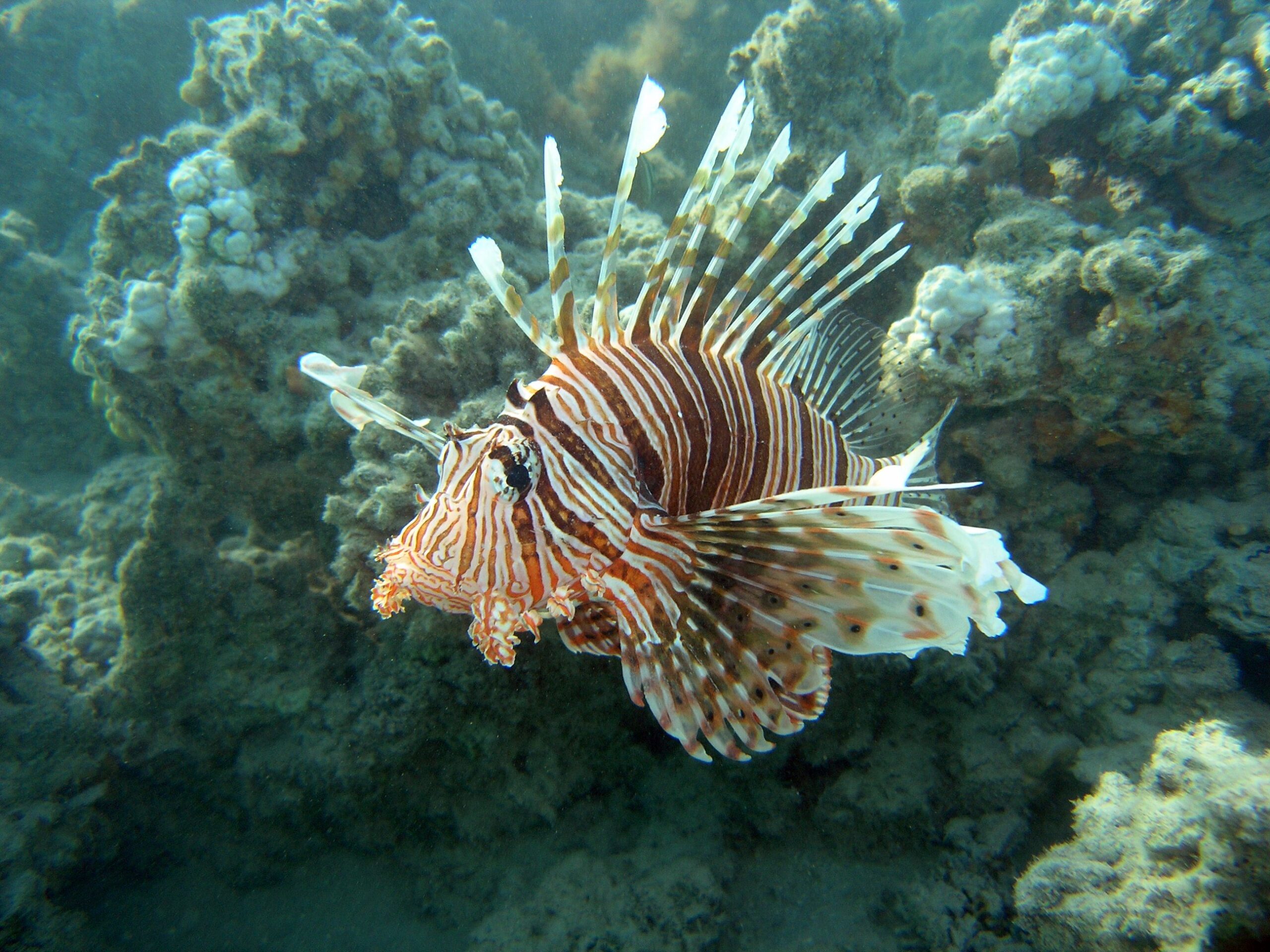
- wide, fan-like fins on the sides, with dark spots and bands
- many thin dark and light stripes across the body and head
- long, separate spines sticking up from the back
- small dark spots on the fins at the back
Quick ID
- Size: up to about 40 cm
- Where: all over the reef, also in shallow water
- When: hunts at dusk – in the daytime it often hovers near overhangs
- Danger: venomous spines – Don’t touch!
- Also called: Devil firefish, common lionfish · Rotfeuerfisch (German) · pesce scorpione (Italian) · skrzydlica wachlarzopletwa (Polish) · koraalduivel (Dutch) · Dragefisk (Danish)
Behaviour
It is in no hurry. In the daytime it often hangs almost still near overhangs and coral blocks. Towards sunset it starts hunting small fish and shrimps. It spreads its big fins to herd the prey into a corner – and then snaps it up in a split second.
Is it dangerous?
Not if you leave it alone. A lionfish does not attack. But the spines on its back and in the fins underneath are venomous – and if you come too close, it may turn and point them at you. People get stung when they touch or grab a lionfish, or simply come too close.
A sting is very painful, and the area swells. It is rarely life-threatening, but take it seriously.
The lionfish is one of the Top-5 poisonous fish in the Red Sea – read about the other four there.
Don’t confuse it with
- Radial lionfish (Pteropterus radiatus) – smaller, and with long white and slimmer “threads” instead of wide fins on the sides. Note that it is just as venomous.
- Scorpionfish and stonefish – relatives that sit still on the bottom and are hard to spot. No big fins, but venomous spines too. The stonefish is the most dangerous of them all – see Top-5 poisonous fish.
Good to know
In the Red Sea the devil lionfish belongs. But it has swum through the Suez Canal into the Mediterranean, where it is now an invasive species. It has spread from the eastern Mediterranean and is now seen in Italy and Croatia.

Find it in the inter active fish guide
The devil lionfish is in the group Hide in the dark – together with bigeyes and squirrelfish, the fish that come out of caves and crevices as the sun sets.
- 115+ species – the ones you are most likely to see
- Sorted by where and how you see the fish, not by family
- Made by a marine biologist
- Checklist integrated
More from the reef
- Top-5 poisonous fish – and how to stay safe
- Safe and responsible snorkeling on coral reefs
- Why the same fish has so many names
Sources: FishBase – Pterois miles; Divers Alert Network – Lionfish stings.