The fish species are much the same in Sharm and Hurghada, but there are differences in what is reported most often. The conditions are also a bit different. Hurghada has more sandy bottoms, and here you will find some other species than what you see along a reef wall.
So here is my list of the fish you are most likely to see in Hurghada. It is based on the species that have been reported most often from the Hurghada area on iNaturalist.

Sohal surgeonfish (Acanthurus sohal)
Grey-white with fine dark stripes and a bright orange mark by the tail. Each sohal guards its own patch of the reef top where the waves break, and it chases other fish away. The orange mark hides a sharp spine – the “scalpel” that gives the surgeonfish their name. So keep a little distance.
Red Sea sailfin tang (Zebrasoma desjardinii)
A tall, flat fish with dark and light bands across the body and a face covered in small pale dots. When it is alarmed or wants to show off, it raises its large fins like a sail. Often seen in pairs along the reef.

Broomtail wrasse (Cheilinus lunulatus)
A large wrasse – up to around half a metre. The male is green with a yellow band behind the head, orange pectoral fins and a frayed tail that looks like an old broom. It is often curious and comes close. It feeds on animals with a hard shell, like snails, crabs and sea urchins.

Red Sea anemonefish (Amphiprion bicinctus)
Orange-brown with two white bands. It lives among the tentacles of a sea anemone and is protected from the stinging cells by a layer of mucus. All anemonefish start life as males – the largest fish in the anemone becomes the female. Look as much as you like, but do not touch the anemone.
Klunzinger’s wrasse (Thalassoma rueppellii)
Green with pinkish-red lines on the head and bars along the body. Always on the move, and it often follows snorkelers to see if you stir up something to eat. It is only found in the Red Sea.

Bullethead parrotfish (Chlorurus sordidus)
A parrotfish with a rounded head. The large males are green and blue, while the females and young fish are a dull brown. Like other parrotfish it scrapes algae off dead coral with its beak – and grinds the coral into sand. A good part of the white sand on the beaches has been through a parrotfish.
Rusty parrotfish (Scarus ferrugineus)
The name comes from the females, which are rusty brown with a yellow tail. The males are green and blue. You can often hear it before you see it – a crunching sound when it bites into the coral. It is only found in the Red Sea and the seas around Arabia.
Bluespine unicornfish (Naso unicornis)
A grey surgeonfish with a short horn on the forehead and two blue spines by the tail. Often in small groups just off the reef, where it grazes on seaweed. Young fish do not have the horn yet.
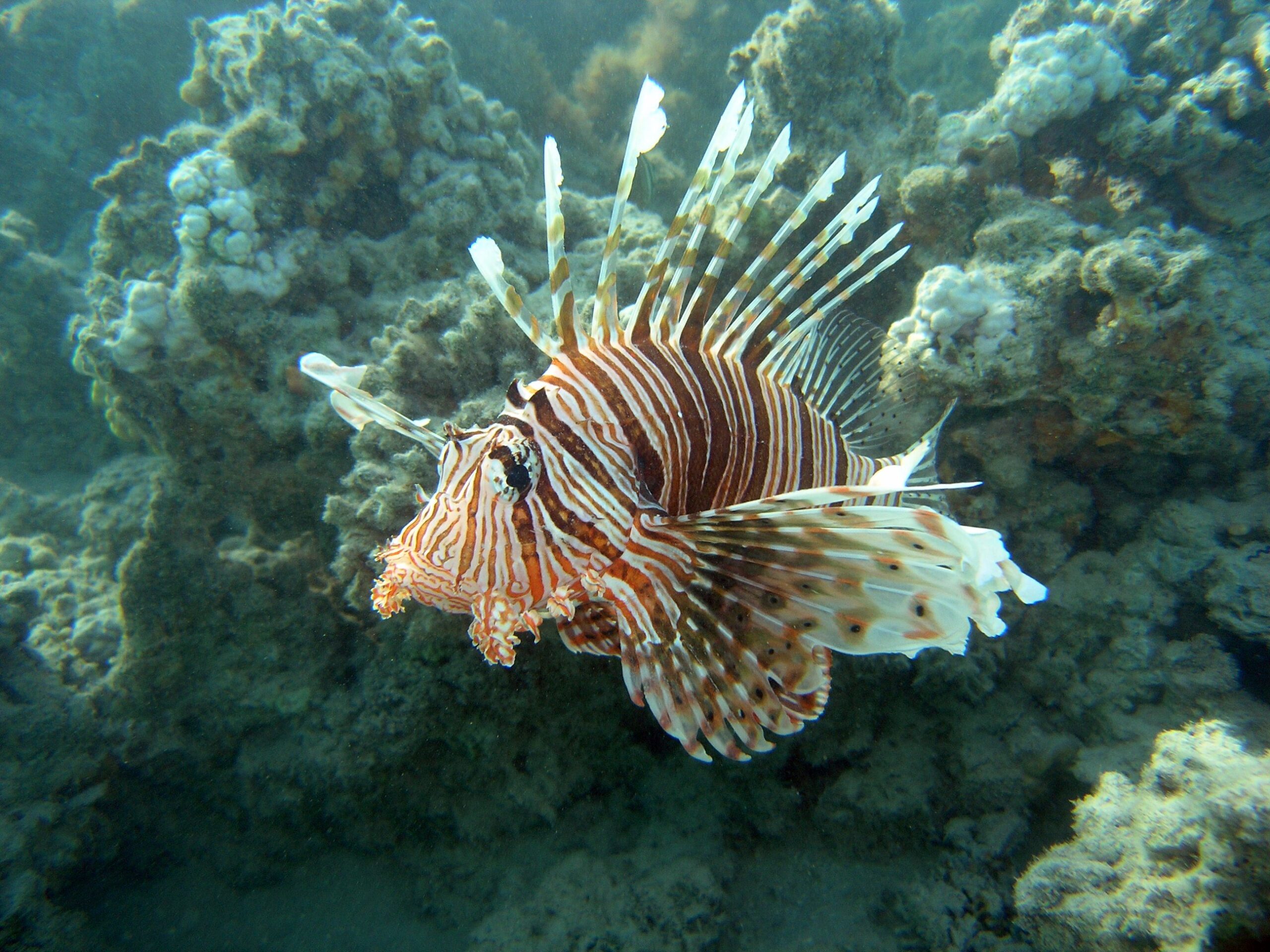
Common lionfish (Pterois miles)
Slow and calm, with long fins spread like a fan. It hunts small fish, mostly at dusk. The spines are venomous, so never touch it. In the Mediterranean it is an invasive species that came in through the Suez Canal – but here in the Red Sea it is at home. Read more about the lionfish of the Red Sea.
White-spotted puffer (Arothron hispidus)
Grey-brown with white spots, and often lying still on the sand or in the seagrass. When it is threatened, it can pump itself up with water. Puffers are poisonous to eat and should not be touched – let it stay calm.
Planning your trip? Read about the best snorkeling spots in Hurghada and check the wind and waves in Hurghada. Going to Sharm? See the fish of Sharm El Sheikh.